Copyright © 2026
Adaptive ML, Inc.
All rights reserved
Privacy PolicyAdaptive ML, Inc.
All rights reserved







NVIDIA GTC 2026: The Inference Era Begins
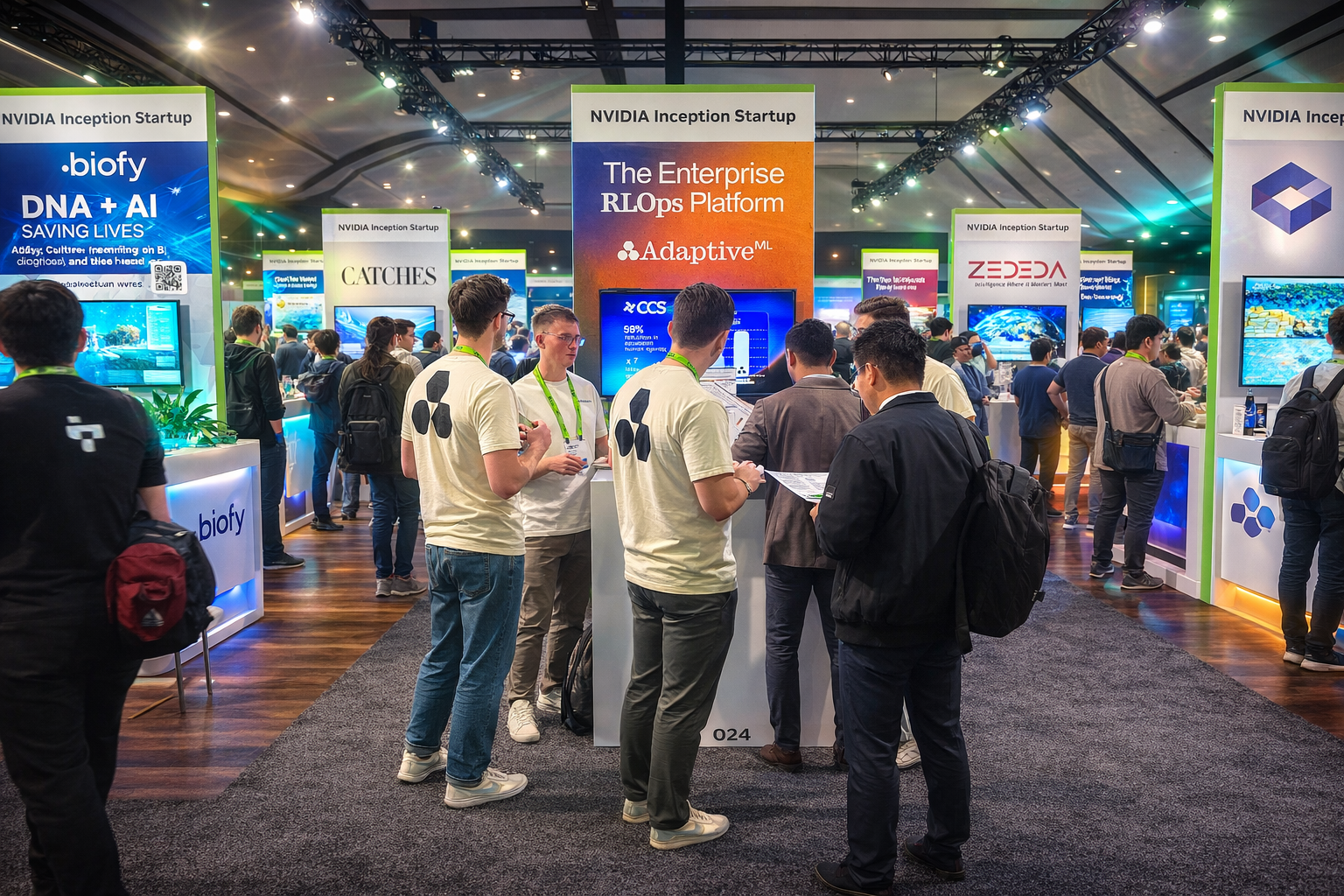
Last week, the Adaptive ML team was on the floor at NVIDIA GTC in San Jose. Thousands of researchers, engineers, enterprise buyers, and builders from across all industries, all in one place, all asking versions of the same question: what does AI actually look like in production?
For us, the answer has always been the same. Specialized models. Owned by the enterprise. Optimized for real tasks. GTC 2026 made clear that the rest of the industry is catching up to that view.
The keynote was organized around inference. Generalist models are commoditizing rapidly, collapsing into focused pricing tiers. The smart action is moving to customization, and more importantly domain-specific optimization, and the infrastructure to support it.
Jensen anchored the hardware portion of the keynote on Vera Rubin, a full-stack computing platform comprising seven chips, five rack-scale systems, and a supercomputer purpose-built for agentic AI. Designed end to end as a single vertically integrated system, it reflects NVIDIA's philosophy of extreme hardware and software codesign.
Perhaps the most significant signal for us: 40% of NVIDIA's GPU demand is now coming from enterprise, sovereign AI, and industrial deployments. Not just hyperscalers. The enterprise market that we have been building for is being validated at the highest level of the industry.
Jensen also had something to say about the training-versus-post-training balance that resonated deeply with our work. Two to three years ago, 90% of compute went to pre-training. That ratio is inverting. And on foundation models versus specialized ones, he was unambiguous: "Frontier models are going to be the best generalists, but unlikely they will be the best specialists." His emphasis on open models was equally notable and it clearly resonated with the room. Nemotron drew significant attention as a foundation for enterprise fine-tuning, and that interest carried directly into our booth conversations.
If the keynote was validating, then the conversations at our booth were energizing.
Over three days, we met with leaders from healthcare, financial services, and enterprise technology. Representatives from big tech like Google, Amazon, Meta, Microsoft, NVIDIA and Apple came by, along with dozens of enterprise buyers at various stages of their AI journey. The energy was different from previous years. People are not asking whether to adopt AI agents anymore. They are asking how to make agents work in production.
A few themes came through repeatedly:
It was also genuinely good to see some familiar faces. Several of our customers made the trip to San Jose, and it’s always good to connect face to face. We are grateful they came, and we are proud of the work we are doing together.
GTC 2026 was a milestone event for the industry as a whole. Not just because of what was announced on stage, but because of what it confirmed about where the market is heading and where Adaptive Engine is positioned within it.
The shift from generalist AI to specialized, enterprise-owned models is not a niche view anymore. It is becoming the consensus. The infrastructure is maturing. The enterprise challenges are clear. And the organizations that move early to own their intelligence layer will have a meaningful advantage over those that wait too long.
We left San Jose with new relationships, sharper thinking, and renewed energy for the year ahead. If you're ready to deploy models that outperform the generalist alternatives at a fraction of the cost, let's talk.
You can book a demo of Adaptive Engine here.